Colloidal silica (silica sol)
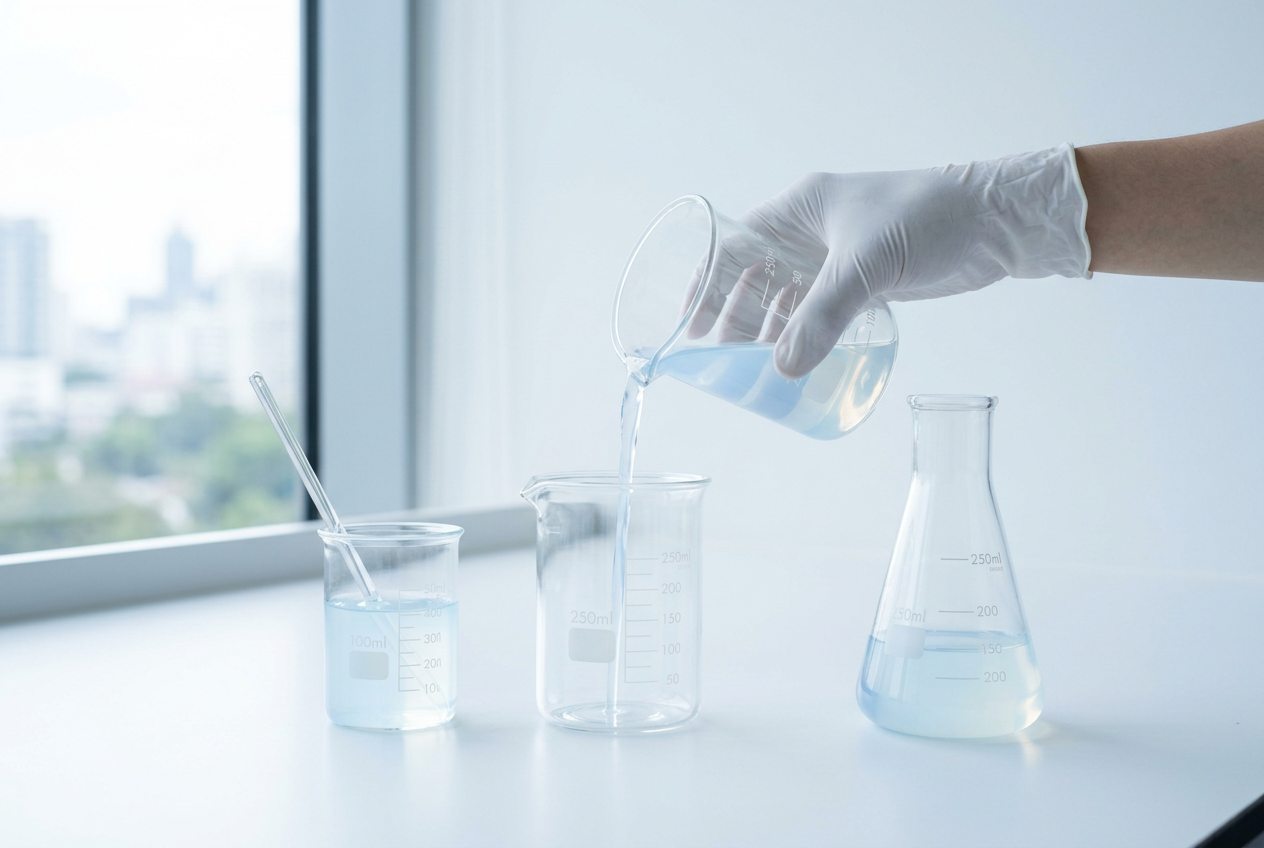
An alkaline colloidal silica with a faint blue opalescence. The particles are discrete spheres of SiO₂ with a high specific surface area and negatively charged silanol groups. When the sol dries, the particles condense through siloxane bonds into a clear film that no longer dissolves in water.
Grades and typical properties
| Grade | SiO₂ % | Stabiliser | Stabiliser % | pH | Density 20 °C, g/cm³ | Viscosity 20 °C, mPa·s | Avg. particle, nm |
|---|---|---|---|---|---|---|---|
| CH83-120 | 20 ± 1 | Na₂O | ≤ 0.25 | 8.5–9.5 | 1.120–1.140 | 2.5–3.0 | 8–10 |
| CH83-120C | 20 ± 1 | Na₂O | ≤ 0.20 | 8.5–9.0 | 1.120–1.140 | 2.0–2.8 | 4–5 |
| CH83-123 | 23 ± 2 | Na₂O | ≤ 0.30 | 8.5–11 | 1.150–1.170 | 2.5–6.0 | 8–10 |
| CH83-125 | 25 ± 2 | Na₂O | ≤ 0.30 | 9.0–11 | 1.165–1.170 | 3.0–6.0 | 8–10 |
| CH83-130 | 30 ± 2 | Na₂O | ≤ 0.35 | 9.0–11 | 1.170–1.200 | 4.0–7.5 | 10–15 |
| CH83-1050 | 15 ± 1 | – | – | 9.5–11 | – | – | 3–5 |
| CH83-A30 acidic | 30 ± 2 | Na₂O | ≤ 0.05 | 2.0–4.0 | 1.190–1.210 | 4.0–7.5 | 8–15 |
| CH83-A1030 acidic, large particle | 30 ± 2 | Na₂O | ≤ 0.05 | 2.0–4.0 | 1.190–1.210 | 4.0–7.5 | 80–100 |
Typical values, not a specification. Each shipment is supplied against the current TDS. Special-purpose grades can be developed to customer requirements.
Where it is used
Coatings
Interior and exterior latex paints, primers and sealers, elastic and textured coatings, and stone-effect finishes. It also goes into functional coatings: fire-retardant, heat-resistant, waterproof, anti-corrosion, zinc-rich and road-marking paints. Combined with lithium or potassium silicate it forms purely inorganic coatings.
Investment casting
CH83-130 (30% SiO₂, low Na₂O) is also supplied as a binder for ceramic shell moulds. Ask for the data sheet.
Refractories
A high-temperature binder for kiln linings and insulation, aluminosilicate fibre, and refractory bricks made from clay, alumina or zirconia, in service at 1200–1700 °C. Refractory use →
Electrostatic flocking
Electro-finishing of flock fibres at around 10–12% addition. Treated fibres separate well and are antistatic. Flocking →
Paper & board
Transparent anti-slip coatings, microparticle retention and drainage, and coated papers. Paper & board →
Polishing
A polishing medium for glass, stone and metal surfaces. For a higher removal rate, see large-particle silica sol.
Textile finishing
An additive in easy-care and anti-slip finishing baths, used with resins and emulsions. Fabric finishing →
Wool spinning
A spinning aid at 2–5%. It raises fibre cohesion, giving fewer breaks and less fly loss. Wool spinning →
Anti-fog coatings
Hydrophilic, transparent anti-fog and anti-drip coatings for films and glass. Anti-fog →
Agriculture
A nano-silica source for silicon fertilizer formulators. Silicon fertilizer →
Steel & catalysts
Inorganic insulating coatings on cold-rolled silicon steel, and a binder for molecular sieves and catalyst carriers.
Dilution calculator
Silica sol is usually diluted with deionised water to a target SiO₂ content before use. Enter the batch size and the two concentrations.
This is a mass balance only. Add water slowly while stirring, and check pH and stability in your own system.
Frequently asked questions
Which CH83-1 grade should I start with?
What is the difference between the alkaline and the acidic grades?
How should colloidal silica be stored?
Is CH83-1 classified as hazardous for transport?
What packaging is available?
Need the full TDS or a trial sample?
Tell us your application and target spec. Our technical team replies within one working day.