Specialty sols
These grades are for the applications standard alkaline colloidal silica cannot cover: acidic or cationic systems, polishing that needs a higher removal rate, and coatings that need a positively charged inorganic particle.
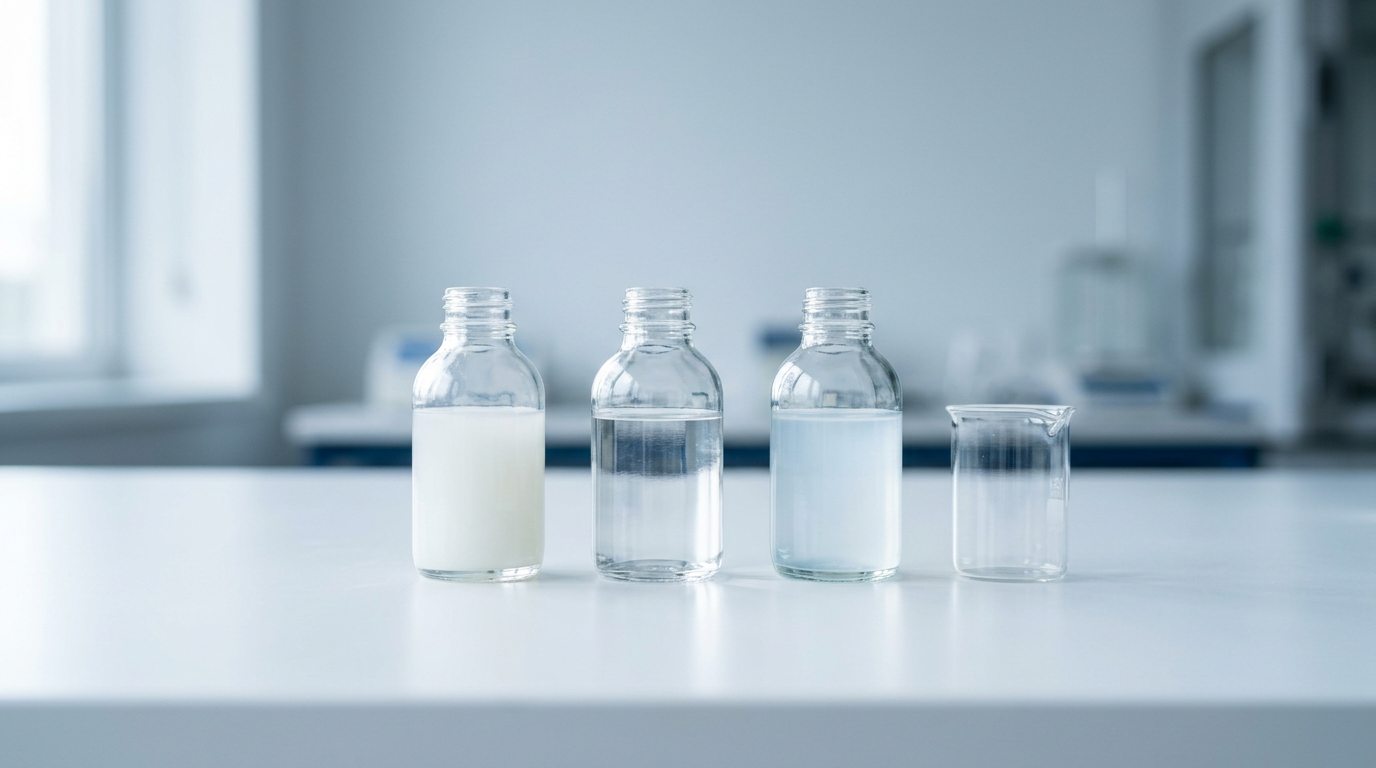
Acidic colloidal silica (CH83-A30)
This colloidal silica is stabilised at acidic pH instead of with alkali. It can be used where an alkaline sol would gel or would upset the system:
- acidic coatings and binders;
- paper anti-slip and surface treatments on lines that run acidic or use cationic additives;
- formulations that must stay low in alkali.
- Grade
- CH83-A30
- SiO₂
- 30 ± 2 %
- Na₂O
- ≤ 0.05 %
- pH
- 2.0–4.0
- Density, 20 °C
- 1.190–1.210 g/cm³
- Avg. particle size
- 8–15 nm
- Particle charge
- Negative
Large-particle colloidal silica (CH83-A1030)
Our standard CH83-1 grades run from 3 to 15 nm. The large-particle grade is for applications that benefit from bigger particles:
- Polishing. Larger particles give a higher material removal rate on glass, sapphire, stone and metals.
- Binders and coatings. Larger particles give lower viscosity at the same solids content and a different packing structure in the dried film.
- Grade
- CH83-A1030
- Avg. particle size
- 80–100 nm
- SiO₂
- 30 ± 2 %
- Na₂O
- ≤ 0.05 %
- pH
- 2.0–4.0 (acidic)
- Density, 20 °C
- 1.190–1.210 g/cm³
This grade is supplied for general polishing. Semiconductor CMP slurries need ultra-high-purity silica made by a different process, which this product is not.
Alumina sol (GHAL)
Alumina sol is a colloidal dispersion of hydrated aluminium oxide. Unlike silica, its particles carry a positive charge, which makes it compatible with cationic systems. Uses:
- Premium electrostatic flocking: electro-finishing of high-grade flock fibre (flocking);
- Inkjet receptive coatings: a porous, dye-fixing layer, used with our cationic emulsion GH2019 (inkjet coatings);
- Refractory and ceramic fibre: a high-temperature binder;
- Catalyst and catalyst carrier for the petrochemical industry;
- Precision casting, glass enamel and ceramics: binder and additive;
- Fabric and fibre processing: a film former; also an emulsifier and stabiliser for pigments and paints.
| Grade | Composition | Solids |
|---|---|---|
| GHAL10 | a(Al₂O₃·nH₂O)·bHX·cH₂O | 10 ± 1 % |
| GHAL20 | a(Al₂O₃·nH₂O)·bHX·cH₂O | 20 ± 1 % |
- Appearance
- Translucent to milky, viscous colloid; thixotropic
- Behaviour
- Thins on contact with acid or alkali; converts to active alumina when dehydrated at high temperature
- pH
- 2.0–4.0
- Particle size
- on request
- Packaging
- 25 kg, 50 kg or 125 kg drums, or to order
- Storage
- 5–35 °C indoors; shelf life 6 months
- Classification
- Non-hazardous for transport; SDS available
Frequently asked questions
What is the difference between alkaline and acidic colloidal silica?
When should I use alumina sol instead of colloidal silica?
Can your large-particle silica sol be used for chip (CMP) polishing?
Need the full TDS or a trial sample?
Tell us your application and target spec. Our technical team replies within one working day.