Application · High temperature
Refractory and heat-resistant binders
Organic binders burn out at high temperature; inorganic silica-based binders keep their strength. Our colloidal silica binds refractory materials in service at 1200–1700 °C, and our inorganic coating binders are used in heat-resistant and fire-retardant coatings.
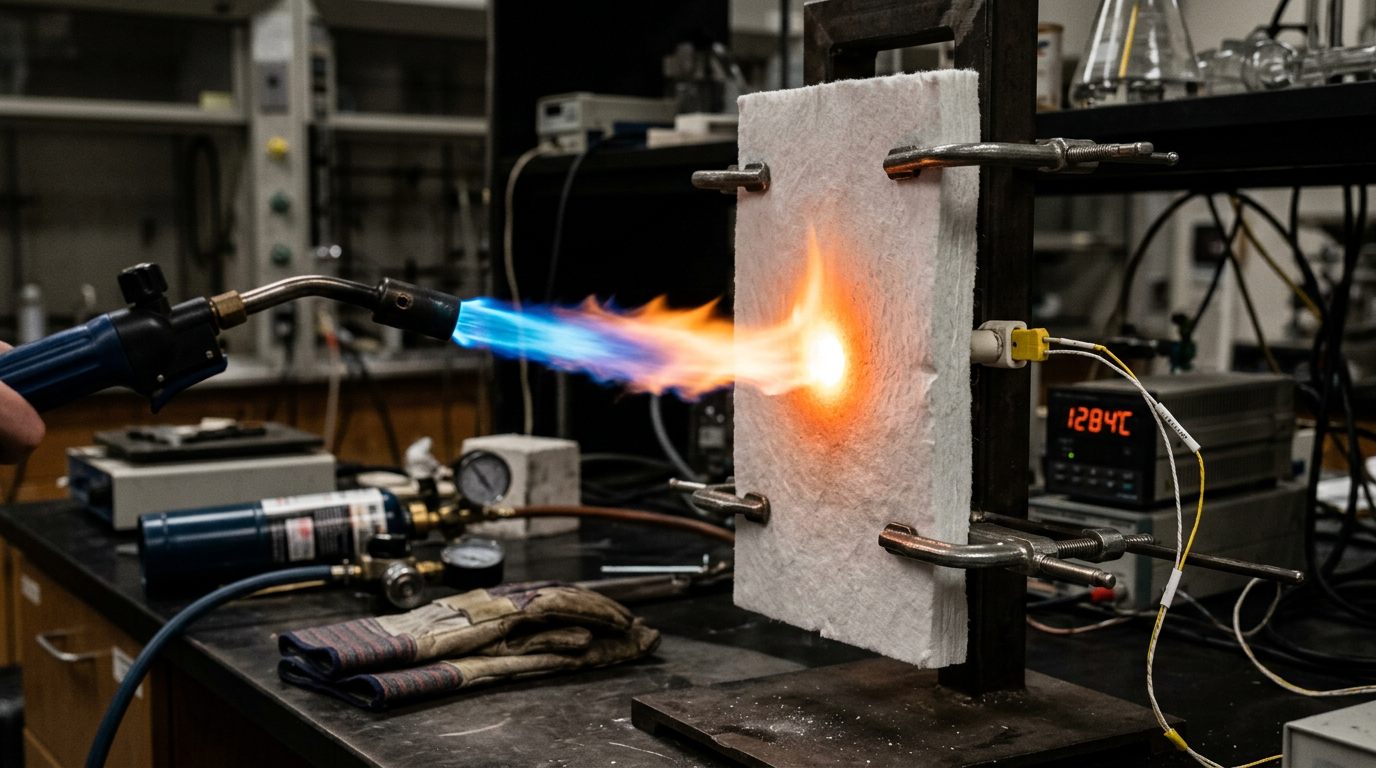
Match the product to the job
| Application | Product | Why |
|---|---|---|
| Kiln linings and furnace insulation | CH83-1 colloidal silica | A high-temperature binder that cannot be substituted in this use |
| Aluminosilicate (ceramic) fibre products | CH83-1 colloidal silica or GHAL alumina sol | Bonds the fibres and stiffens boards and shapes |
| High-grade refractory bricks from clay, alumina or zirconia | CH83-1 colloidal silica | Binds the refractory aggregate; service temperatures of 1200–1700 °C |
| Heat-resistant coatings, purely inorganic coatings | GHNK | An inorganic binder with strong adhesion and water resistance |
| Heat-resistant coatings to about 1000 °C; thick fire-retardant coatings | CH-1304 | Polymer-modified nano silica sol, zero VOC |
| Bonding high-temperature materials | GHSL lithium silicate | A self-curing inorganic binder |
What happens to colloidal silica when it is heated
Our lab characterises the dried silica gel as follows. These stages explain why the binder holds its strength at temperatures where organic binders have burned away.
| Temperature | Change in the dried silica |
|---|---|
| ≈ 150 °C | Physically adsorbed water is released from the gel |
| 400–700 °C | Surface silanol groups condense. There is a small, endothermic weight loss, but the particles remain otherwise unchanged |
| ≈ 700 °C | The last structural water bound to the particle surface is removed |
| ≈ 800 °C | Glass transition: the mechanical strength changes as surface defects between particles react |
| ≈ 1200 °C | Transformation toward cristobalite (exothermic peak) |
| ≈ 1700 °C | Melting point |
The transition temperatures shift with the amount of sodium stabiliser. Our alkaline CH83-1 grades are produced with Na₂O ≤ 0.35%; the acidic grades CH83-A30 and CH83-A1030 with Na₂O ≤ 0.05%.
Working with silica binders in refractories
- Keep the sol stable until use. Avoid contact with multivalent salts and acids before mixing. Silica sol gels fastest at around pH 5–6.
- Remember that drying sets the bond. The silica network forms as water leaves the body, and this cannot be reversed. Plan drying before firing.
- Choose the sodium level. Lower-sodium grades keep refractoriness higher. Where sodium must be minimised, use the acidic grade CH83-A30 (Na₂O ≤ 0.05%).
Frequently asked questions
What temperature can colloidal silica-bonded refractories withstand?
Refractories bonded with colloidal silica are used at service temperatures of 1200–1700 °C, depending on the refractory aggregate (clay, alumina or zirconia).
Which grade is best for ceramic fibre boards?
Start with one of our higher-solids grades, CH83-125 or CH83-130. Tell us your fibre type and forming process and we will recommend a grade and send a sample.
What is the difference between a refractory binder and a heat-resistant coating binder?
A refractory binder holds aggregate or fibre together inside a refractory body. A heat-resistant coating binder forms a paint film on a substrate. For refractory bodies use CH83-1 colloidal silica; for coatings use GHNK or CH-1304.
Need the full TDS or a trial sample?
Tell us your application and target spec. Our technical team replies within one working day.